Crypto-Optical Technology Hold up your phone.
Know if it’s real.
Every product already carries a printed code. Around ours we print a second pattern, so fine that a photograph of it does not come back the same. The original passes a smartphone check. The reproduction fails. That is product authentication - printed onto your product or label, and read by the camera people already carry.
Printed dot by dot. Broken by any copy.
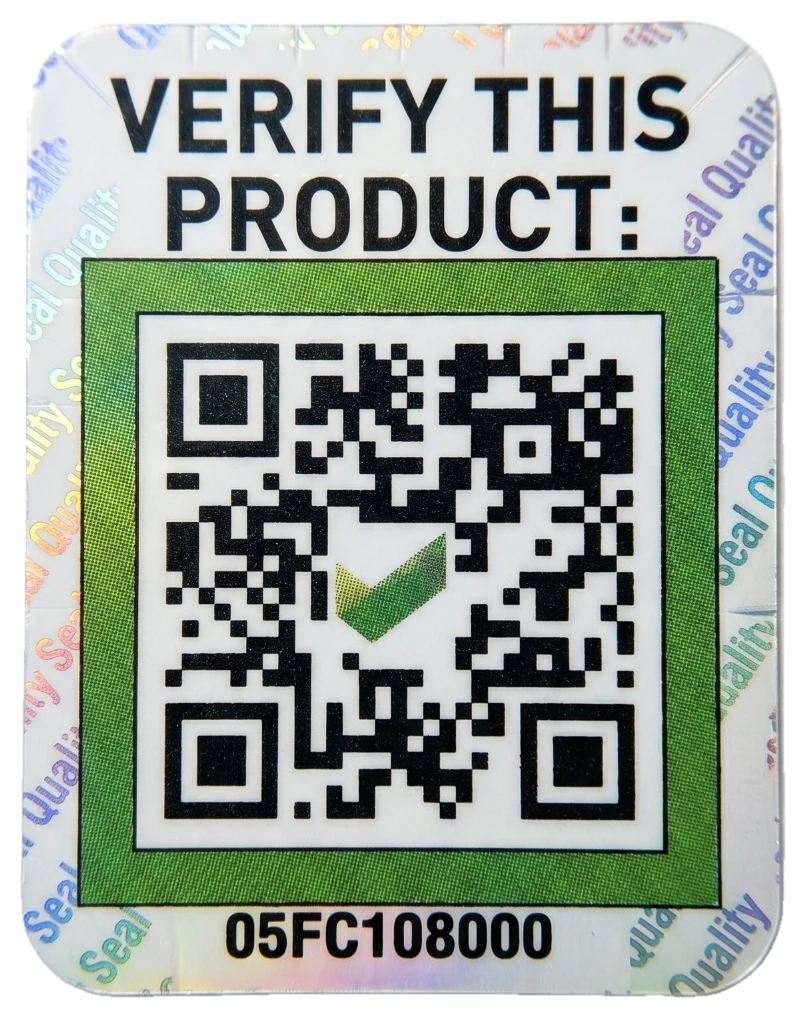
One camera on your line.
Any phone in the field.
On your line
Where the code is printed and recorded
Sticker or label
Delivered as ready-to-apply stickers, or integrated into your existing label artwork.
Standard printing
Standard print processes and materials - no special inks.
Works with your systems
The layer sits in a standard code, so existing scanners, apps and systems keep reading it.
One serial per item
Every code is unique, so each product can be traced as an individual item, not a batch.
In the field
Where the code is checked
Any smartphone camera
No laboratory and no special reader - the camera people already carry.
Works offline
The answer comes from the code itself rather than from a server - in a warehouse, at a border, anywhere coverage is weak.
Checked cryptographically
The phone reads the bit blocks and checks them against the key. A reprint does not match.
How Crypto-Optical Technology compares to standard QR codes, holograms and NFC.
| Criterion | Crypto-Optical Technology | Standard QR code | Hologram | NFC tag |
|---|---|---|---|---|
| ProofA copy fails the check | ✓Yes | ✗No | ~By eye | ~Varies |
| ControlEvery item serialised and traceable | ✓Yes | ~Serial only | ✗No | ✓Yes |
| ConnectionOpens a digital service on scan | ✓Yes | ✓Yes | ✗No | ✓Yes |
| Where the security sitsWhat a copier has to reproduce | ✓Standard print | ✗Nowhere | ~Special foil | ~Chip |
| Checked with | Phone camera | Phone camera | The human eye | NFC-capable device |
A standard QR code identifies a product; it can be copied perfectly, so a counterfeit carrying the same code scans identically. Crypto-Optical Technology authenticates: the copy fails.
Trusted by manufacturers including BOSCH, STIHL, LIQUI MOLY and Chillington. Volume figure: authentic.network, 2026.
About the technology.
What is Crypto-Optical Technology?
Crypto-Optical Technology is authentic.network's patented authentication technology. It adds a security layer of deliberately manipulated bit blocks, arranged according to a cryptographic key, around a printed code on the product. The code stays readable like any other, but photographing, scanning or reprinting destroys the manipulations, so a reproduction fails verification.
What is a bit block?
A bit block is a small group of print dots that have been deliberately manipulated to carry digital information. Together, the bit blocks in a code form a pattern generated from a cryptographic key. A phone camera reads them back; photographing, scanning or reprinting destroys them, so a copy fails the check.
Can the code be copied?
The visible QR code can be reprinted, but the security pattern cannot be copied: photographing, scanning or reprinting destroys the manipulated bit blocks. What comes out looks like the code, but it is not a copy of it - and it fails verification.
How is this different from a standard QR code?
A standard QR code identifies a product: it tells you what the item claims to be. It can be copied perfectly, so a counterfeit carrying the same code scans identically. Crypto-Optical Technology authenticates: it confirms that the item in front of you is the original that claim belongs to.
Do we need special inks, printers or hardware?
No. The mark runs on your existing print process. You get it either as a sticker we print and ship to you, or integrated into your existing label artwork. No new machines and no special inks are needed in either case.
Does verification work without an internet connection?
Yes. The answer is derived from the mark itself rather than looked up on a server, so verification works offline. That matters at border checks, in warehouses and in regions with unreliable coverage.
Do our existing scanners and systems still work?
Yes. The mark stays a readable standard code, so anything that reads codes today keeps reading it. The crypto-optical layer is added around the code rather than replacing it, which is why the technology adds trust to the standards you already use instead of forcing a migration.
What data does authentic.network record?
Verification scans: when and where a mark was checked and whether it passed. The system does not require you to hand over full supply-chain event data to work.
See it fail.
The Sample Kit is one genuine code and one perfect reprint, sent to your desk. Try to tell them apart, then scan both.
Real impact.