Brand protection that stops counterfeits at the first scan.
Counterfeiters can copy your packaging down to the last detail. They cannot copy the security layer printed on it. Anyone with a smartphone can tell your original from a reprint - on the spot, without an app.
- 150+
- countries where products are checked
- ~1 s
- from scan to answer
- Offline
- with the authentic app, still counted
- ISO 27001
- certified hosting
What a counterfeit costs you.
of everything the EU imports is counterfeit - nearly one in every twenty euros. Worldwide, that trade is worth $467 billion a year. Source: OECD / EUIPO, Mapping Global Trade in Fakes 2025. Figures for 2021, by value.
Every counterfeit sold is a sale that did not happen, often at a price you cannot match.
A copy fails the check, so a buyer can tell before they pay.
Fake lubricants, tools or medicines do not perform like the original - and the failure lands on your brand.
A failed scan warns the person holding the product, on the spot.
Once customers doubt one product, they doubt the brand - including every original you sell.
Every original proves itself in one scan, with any smartphone.
Without a check on the item itself, you cannot show a customer, a distributor or a court which unit came from you.
The check happens on the item, so you can show which unit is yours.
Everyone in the chain can verify. With the phone they already have.
Check at the border
With the authentic app, verification works offline - a result in warehouses and at border checks, wherever coverage is weak.
Check on arrival
Verified before goods are accepted into stock, without special readers.
Check before use
Camera on the product, answer on the screen in about a second. No app, no login.
One check for everyone. Every role scans the same layer and gets the same answer.
Anyone can reprint the code. Nobody can reprint the pattern.
A counterfeiter can photograph your mark, scan it and print it again. The visible code survives that - every copy scans.
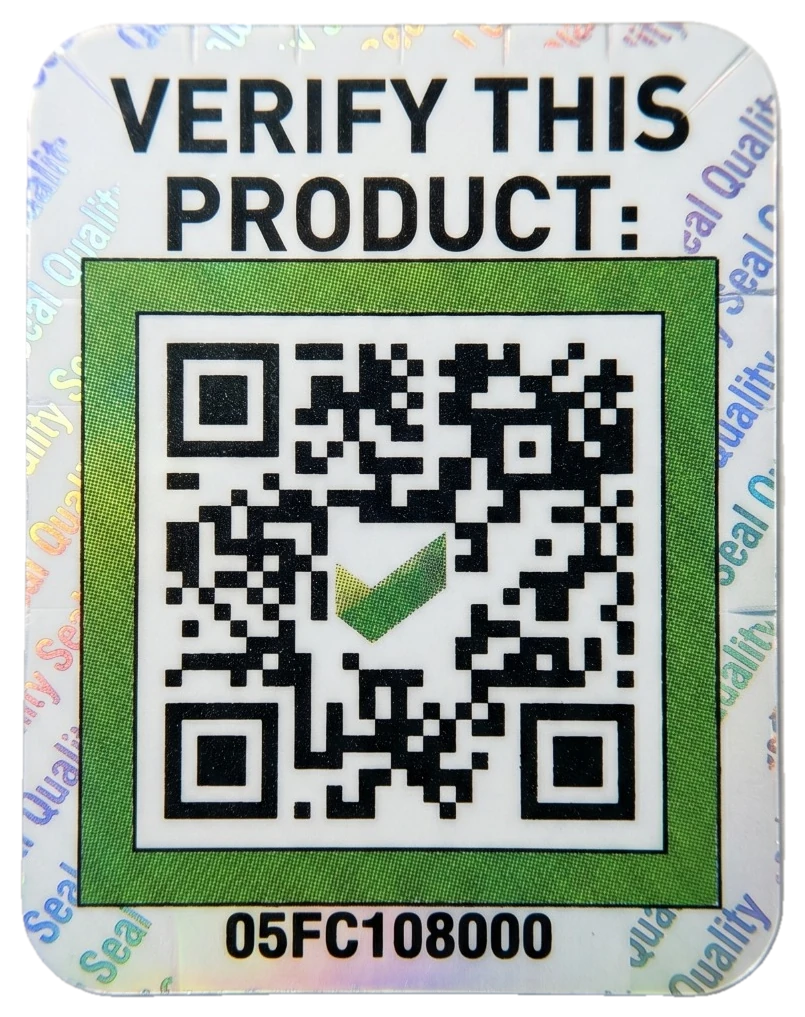
The black-and-white pattern a phone reads. It carries the serial number, and it reprints without trouble.
Microscopic changes in the printed structure, unique to that one item. Printing a printed code destroys them.
So the check never asks whether the code scans. It asks whether the pattern is still the one that was printed - and a reprint answers no, wherever it turns up.
How it compares to QR codes, holograms and NFC tags
| Criterion | authentic.network code | Standard QR code | Hologram | NFC tag |
|---|---|---|---|---|
| A copy fails the check | Yes | No | By eye only | Varies |
| Every item serialised | Yes | Serial only | No | Yes |
| Where the security sits | Standard print | Nowhere | Special foil | Chip |
| Checked with | Phone camera | Phone camera | The human eye | NFC-capable device |
Every failed check tells you where to look.
Every scan is counted - with its time, its place and its result, and without needing an internet connection. Failed checks turn a suspicion into evidence.
- Failed checks by location and over time
- Hotspots visible market by market
- No supply-chain data required
40 million products.
One trusted identity.
LIQUI MOLY protects its lubricant range worldwide with authentic.network - fully integrated into its system landscape, from ERP connection to track & trace and grey-market control. Customers verify every product before it is opened, in over 150 countries.
“We want to be able to trace our entire supply chain, from production to the end customer. And we want to do so worldwide. This is essential to delivering on our quality promise.”
About brand protection.
How does brand protection work without special hardware?
The protection is printed into the product's code as a security layer of manipulated bit blocks. Any smartphone camera can read and check it, so there are no readers to buy, no special inks and no app to install.
What is brand protection with authentic.network?
authentic.network protects products with a copy-evident code: a layer of manipulated bit blocks printed into the code on the product, its packaging or a label. A reprint still scans but fails the check. Anyone verifies with a smartphone, no app, in about a second; offline with the authentic app - and every scan is counted with its time, place and result.
Can counterfeiters copy the security layer?
They can reprint the visible code, but not the security pattern: photographing, scanning or reprinting destroys the manipulated bit blocks. The reprint looks like the original, but it fails verification.
What happens when someone scans a counterfeit?
The check fails and the person scanning sees it on the spot. The failed check is recorded with its time and location, so you can see where counterfeits appear.
How long does a check take?
About a second, often less: camera on the code, answer on the screen.
Who can verify a product?
Anyone with a smartphone: inspectors and customs officers, distributors and retailers, and end customers. Everyone scans the same code and gets the same answer.
Does verification work offline?
Yes, with the authentic app. The answer comes from the code itself rather than from a server, so a product can be checked in warehouses, at border checks and in regions with unreliable coverage. Every check is counted, with or without a connection.
Works together with
Try to tell them apart.
The Sample Kit is one genuine code and one perfect reprint, sent to your desk. Compare them by eye - then scan both.
Real impact.