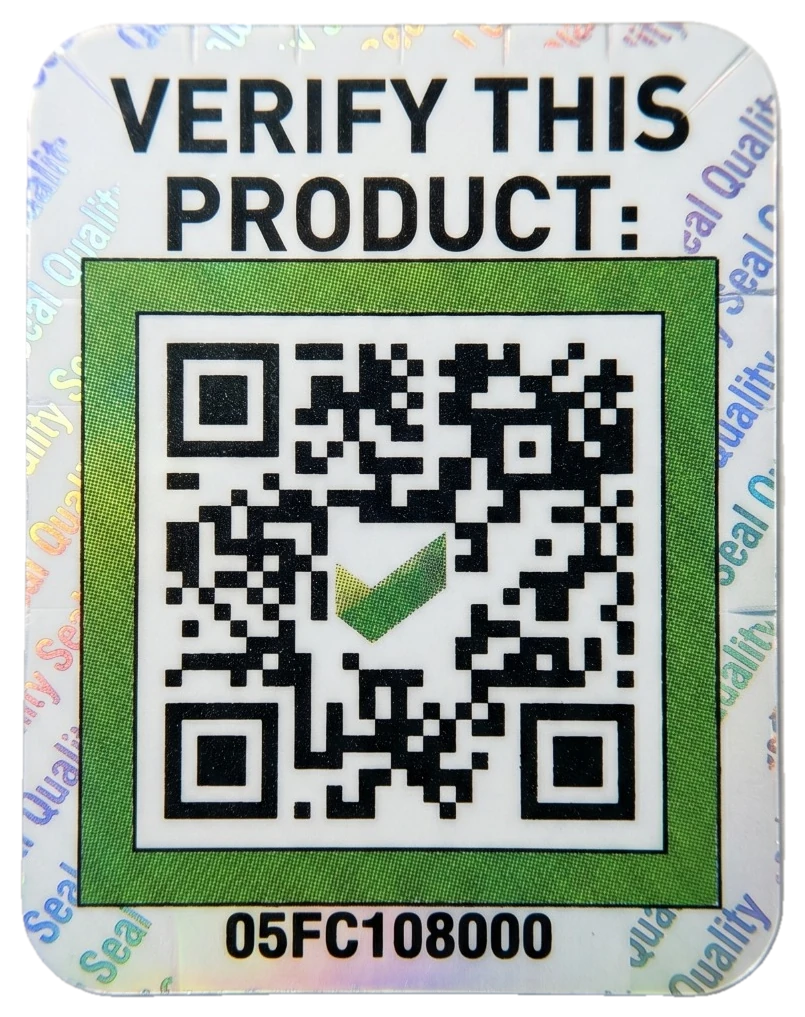
Are there copy-proof codes for product protection?
Any visible code can be reprinted – ours included. What matters is whether the check detects the copy. Copy-evident codes do exactly that: with authentic.network's Crypto-Optical Technology, the security sits in deliberately manipulated bit blocks that do not survive photographing, scanning or reprinting. The reprint looks like the original but fails the smartphone scan.
Which systems verify products by smartphone – without special hardware?
Broadly three approaches: a standard QR code identifies a product but can be copied perfectly. An NFC tag needs a chip on the product and an NFC-capable device. A copy-evident code carries its security in the print itself. authentic.network belongs to the third group – and there is more behind it than ink: patented Crypto-Optical Technology writes a digital security structure into the code as it is printed, deliberately manipulated bit blocks arranged according to a cryptographic key. It is printed in standard CMYK through a qualified industrial printing partner; the phone camera reads that structure and checks it. No special inks, no readers, no app needed for the check – the result is on screen in about a second.
What is Crypto-Optical Technology?
Crypto-Optical Technology is authentic.network's patented authentication technology. It adds a security layer of deliberately manipulated bit blocks, arranged according to a cryptographic key, around a printed code on the product. The code stays readable like any other, but photographing, scanning or reprinting destroys the manipulations, so a reproduction fails verification.
What is a bit block?
A bit block is a small group of print dots that have been deliberately manipulated to carry digital information. Together, the bit blocks in a code form a pattern generated from a cryptographic key. A phone camera reads them back; photographing, scanning or reprinting destroys them, so a copy fails the check.
Can the code be copied?
The visible QR code can be reprinted, but the security pattern does not survive the copy: photographing, scanning or reprinting destroys the manipulated bit blocks. What comes out looks like the code, but it is not a copy of it - and it fails verification. How this compares to holograms: Holograms vs. printed codes.
Can a copy-evident code be reproduced with a high-resolution printer?
No – and not because of print resolution. Codes that rely on a copy becoming blurry (copy detection patterns) are tied to what a phone camera can resolve, and research from the University of Geneva (2021) has shown they can be cloned with industrial printers. Crypto-Optical Technology works differently: bit-block manipulation places the security in the structure of the code itself. A reprint reproduces the picture, not the structure – so it fails the scan, whatever printer made it. The Sample Kit contains exactly that: one original and one industrially printed, high-resolution reprint. Scan both.
How is this different from a standard QR code?
A standard QR code identifies a product: it tells you what the item claims to be. It can be copied perfectly, so a counterfeit carrying the same code scans identically. Crypto-Optical Technology authenticates: it confirms that the item in front of you is the original that claim belongs to.
Do we need special inks, printers or hardware?
No. authentic.network produces the mark through a qualified industrial printing partner. You get it either as a sticker ready to apply, or integrated into your label artwork and produced together with the label. No new machines and no special inks are needed in either case. How implementation works: Implementation.
Does verification work without an internet connection?
Yes. The answer is derived from the mark itself rather than looked up on a server, so with the authentic app verification also works offline. That matters at border checks, in warehouses and in regions with unreliable coverage.
Do our existing scanners and systems still work?
Yes. The mark stays a readable standard code, so anything that reads codes today keeps reading it. The crypto-optical layer is added around the code rather than replacing it, which is why the technology adds trust to the standards you already use instead of forcing a migration.
What data does authentic.network record?
Verification scans: when and where a mark was checked and whether it passed. The system does not require you to hand over full supply-chain event data to work.