Each code carries individually configured bit-block manipulations. The scan evaluates that structure – not just a serial number.
Printed vs. holographic security
Are holograms more secure than printed codes?
Printed does not mean insecure. Holographic does not mean uncopyable. Whoever puts all printed security features in one basket is comparing manufacturing processes, not security processes.
The argument you may have heard
"A good printer beats a phone camera."
Some arguments against printed security reduce authentication to a race between printers and smartphone cameras: if a printer can reproduce the image, the copy passes.
That skips the decisive question: what must a counterfeit reproduce to pass authentication? A visible effect? An individual security structure? A valid identity linked to one specific product?
That is where the comparison should begin.
Attack 1 · Copy detection patternsPrinted at the limit.
Printed at the limit.
Copied at the limit.
A copy detection pattern is a fine noise field printed into or next to a code at the printer's maximum resolution. The scan checks whether detail was lost – the assumption being that a copy always blurs. Researchers at the University of Geneva tested that assumption with machine learning:
How a copy detection pattern is clonedDocumented in research, 2019–2024
1Collect genuine printed codes and scan them at high resolution.
2Train a machine-learning model to recover the digital pattern from the print.
3Reprint the recovered pattern on an industrial press – the same class of machine as the original.
✓ Accepted
4Check it with standard detection metrics.
A successful attack exposes a verification method. It does not discredit every printed security technology.
Research has demonstrated machine-learning attacks against specific copy detection patterns and detection methods – and better detection methods in response.2 The relevant question is always which features were reconstructed, which checks were defeated, and under what conditions. Applying those results to every printed security feature is a leap the evidence does not support.
Attack 2 · HologramsThe holographic effect
The holographic effect
is only the beginning.
An embossed hologram is a manufactured optical structure – made from a metal master, and reproducible with the same techniques: lift the relief, plate it, emboss it again.3 Its appearance alone does not establish that a label is original.
How an embossed hologram is replicatedIllustration of embossed-hologram replication
1Separate a genuine label from its backing – the embossed relief is exposed.
2Electroform the relief in nickel. The result is a metal master of that exact surface.
3Emboss copies from the master – or re-originate the hologram from scratch for the best fakes.
Replica produced
4Does the replica pass authentication? That requires a system-specific test.
Appearance reproduced ≠ authenticity established
Wherever a hologram is checked by eye, appearance is all a counterfeit needs: in one tested batch of seized excise holograms, 870 of 894 were fake.4
What about app-verified holographic labels? A vendor of such labels writes in its own patent about the base features of optical security:
"Such security features may, in the case of complete knowledge, be replicated at least up to such an extent that the replicate stands up to an examination by means of a – comparatively coarsely resolving – camera."US 11,390,107 B2, Summary of the invention5
The patent distinguishes these reproducible base features from randomly selected portions, used to make individual labels harder to replicate – in its words, to "aggravate replication". That distinction matters: the security argument depends on a specific construction and its verification – not on the word "hologram". Which reproductions the complete process actually rejects is the question every buyer should ask.
How well automated hologram checks hold up is an open research question. A 2026 study on hologram verification notes that existing methods' "capacity to detect real, dynamic fraud cases (e.g. handcrafted hologram) has not been evaluated to date" and that few of them "can generalize to new, unseen attacks".6
What it means for a brand: a foil label on every unit, applied separately from your artwork, an app for whoever checks – and a security claim that rests on how that specific system was tested.
The reprint test · Crypto-Optical TechnologyReproduce the appearance.
Reproduce the appearance.
Then test the authenticity.
Crypto-Optical Technology combines individually configured bit-block structures, cryptographic identity checks and scan monitoring. Reproducing a visible code is only one part of the challenge: the security structure must pass verification, the identity must match its assigned product, and suspicious reuse must be detected.
An industrial reprint of a Crypto-Optical code – and what the scan saysTest it yourself · Sample Kit
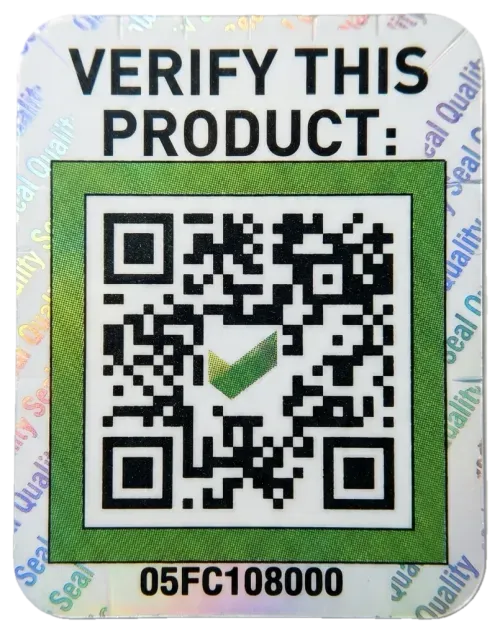
1Take a genuine code and scan it at high resolution. The glitter film is an additional visual feature. The security sits in the green frame.
2Rebuild the code and the green frame – visually matching.
3Reprint it on an industrial press, at high resolution.
✗ Not original
4Scan it with any phone camera, no app. The reproduced security structure fails verification.
✓ Copy rejected
The industrial reprint in our Sample Kit reproduces the appearance – but fails verification: the scan says Not original. Scan the original and the reprint yourself.
✗Copy detection pattern
ML clone – standard metrics could not reliably tell it apart.
?Hologram label
Appearance reproducible – authenticity depends on the specific system.
✓Crypto-Optical Technology
Industrial reprint – fails verification. Test it with the Sample Kit.
Why it holds · Crypto-Optical TechnologyA printer's resolution
A printer's resolution
answers none of these questions.
Crypto-Optical Technology does not rest on how sharp a print is, or how a surface glitters. Three layers of protection:
The code's identity is tied to its product data, with additional cryptographic checks in the verification.
Every scan is recorded with time and place. Unusual repeated use of the same identity is flagged for investigation.
The glitter film on our sticker is an additional visual feature – the verification does not depend on it. Any phone camera, no app. Printed in standard CMYK by authentic.network through a qualified industrial printing partner – into your label or as a ready-to-apply sticker.
Compare the evidenceSix questions to ask
Six questions to ask
any vendor – including us.
- Which reproductions and attack methods were tested?A photocopy is not an attack. An industrial reprint, a machine-learning clone and a plated copy are.
- Who ran the test – the vendor, or someone independent?
- Is an individual security feature verified, or only a valid identifier?
- How often were counterfeits accepted – and originals rejected?
- Does everyone who checks need the vendor's app?Customers, retailers, workshops, customs.
- What does every unit need extra – and how are reuse and product mismatches handled?