Digital Product Passport The Digital Product Passport is only as real as its code.
A passport links data to a product through a code on the item. If that code can be copied, the passport travels with the counterfeit - and still looks valid. Our mark closes that gap: it protects your products today and carries your passport when the rules arrive.
A product passport is a product's record, opened by scanning the item. We make sure the scan opens the record of the real item - not of a copy.
A Digital Product Passport (DPP) is a structured, machine-readable record of a product's identity, composition, origin and lifecycle, reachable through a data carrier such as a QR code on the product. Under EU law it is introduced product group by product group. authentic.network provides both from one serialised, copy-evident mark: protection against counterfeits today, and the data carrier that keeps the passport bound to the genuine item.
Brand protection now. Your passport when the rules arrive.
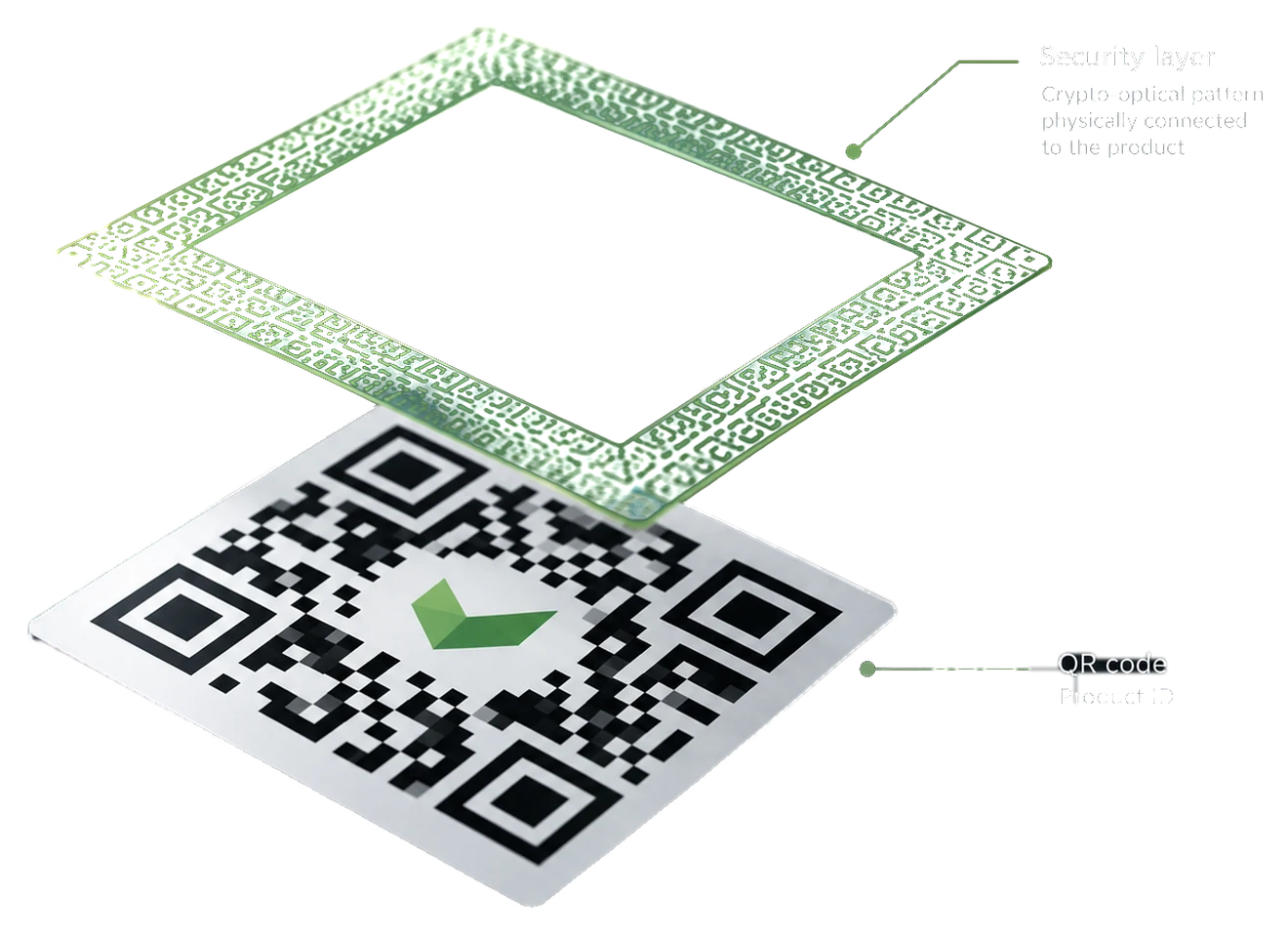
The same mark on your product does two jobs. You do not have to choose between protecting your brand and preparing for the Digital Product Passport - one code gives you both.
Brand protection, from day one
The crypto-optical layer makes every copy detectable. Inspectors, distributors and customers verify originals with any smartphone, even offline.
Your Digital Product Passport
The serialised code gives every item its own identity and opens its passport data. When passport rules reach your product group, the passport goes onto the mark you already print.
What the rules actually say - and when.
There is no single DPP deadline. The Ecodesign for Sustainable Products Regulation sets the framework; obligations arrive product group by product group through delegated acts, each followed by a transition period of at least 18 months.
The framework: ESPR
Regulation (EU) 2024/1781 enters into force. It makes product passports possible, but on its own it obliges no manufacturer to issue one.
The working plan
The Commission publishes its ESPR Working Plan 2025-2030 and names the first priority product groups.
The EU DPP Registry
Implementing Regulation (EU) 2026/1778 sets the rules for the central registry that stores each product's unique identifier.
The battery passport
Under the Battery Regulation (EU) 2023/1542, batteries for electric vehicles and light means of transport, and industrial batteries above 2 kWh, need a passport reachable through a QR code. It is the first legally fixed passport in EU law.
The first product groups
Iron and steel (2026); textiles, tyres and aluminium (2027); furniture (2028); ICT products and mattresses (2029). These are target dates for adopting the rules, not compliance deadlines.
Sources: Regulation (EU) 2024/1781; Regulation (EU) 2023/1542; Implementing Regulation (EU) 2026/1778; European Commission, ESPR Working Plan 2025-2030 (COM(2025) 187). Status: September 2026.
A passport is only as trustworthy as the code that carries it.
The rules define what a passport must contain and that it must be reachable through a carrier on the product. A standard QR code meets that requirement - and can be photographed and reprinted in seconds. Put it on a counterfeit, and the fake opens the genuine passport: complete, compliant and wrong.
The copy inherits the passport.
A reprinted code opens the same record as the original. Anyone scanning it sees a valid passport for a product that is not the real one.
The copy fails before the passport opens.
A reproduced mark does not pass verification, so a passport cannot be moved onto a fake. The record stays with the item it describes.
Start with protection. Add the passport later - on the same mark.
For most product groups, passport obligations are still ahead. That is exactly why the carrier matters now: whatever you print today will still be on your products when the rules arrive.
Protect your brand
Put the mark on your products and make counterfeits detectable from the first scan.
Switch on the passport
Link passport data to the serialised codes that are already on your products.
- No second code on the pack
- No second supplier
- No second rollout
- No packaging redesign
Others carry the data. We protect it - and make every scan count.
A typical passport setup is a data platform with a standard QR code on the product. It delivers the data, but anyone can copy the code. Our mark adds protection, analytics and customer engagement to the same scan.
| Criterion | authentic.network | Typical passport setup |
|---|---|---|
| Passport data from the productReachable through the code | ✓Yes | ✓Yes |
| Own identity for every itemNot just the batch | ✓Serial on every mark | ~Varies |
| A copy of the code is detectedWhat a counterfeiter can't reproduce | ✓Copy fails verification | ✗No - standard QR code |
| Checked offlineBorder, warehouse, weak coverage | ✓Yes | ~Varies |
| Scan analyticsWhere, when, genuine or not | ✓Yes | ~Varies |
| Customer engagementWhat opens after the scan | ✓Yes | ~Varies |
"Typical passport setup" means a passport data platform with a standard QR code as the carrier. Individual offers differ.
Every scan becomes insight.
- Where your products are scanned, market by market
- Where copies surface - failed checks by location
- Grey-market signals - units verified outside their intended market
- Scan activity over time, so trends show before they cost you
Built on verification scans alone - you do not have to hand over supply-chain data.
Every scan reaches your customer.
- Product information and passport data, right after the check
- Registration and warranty in one scan
- Campaigns and loyalty, directly on the product
The moment a customer confirms the product is genuine is the moment they are most willing to engage.
About the Digital Product Passport.
What is a Digital Product Passport?
A Digital Product Passport is a structured, machine-readable record of a product's identity, composition, origin and lifecycle. It is reached through a data carrier on the product, such as a QR code, and linked to a unique product identifier.
When does the Digital Product Passport become mandatory?
It depends on the product group. The first legally fixed passport is the battery passport, which applies from 18 February 2027 under the EU Battery Regulation. For other product groups, obligations arrive through delegated acts under the Ecodesign for Sustainable Products Regulation, each followed by a transition period of at least 18 months. The Commission's working plan targets iron and steel first, followed by textiles, tyres and aluminium.
Does it apply to products made outside the EU?
Yes. Once a delegated act covers a product group, its requirements apply to products placed on the EU market, wherever they are manufactured.
What does the data carrier on the product have to do?
It makes the passport reachable from the product and links it to a unique identifier, typically through a QR code. A standard QR code does this, but it can be copied onto a counterfeit together with the link to the genuine passport.
We don't need a Digital Product Passport yet. Why start now?
Because the code you print today will still be on your products when passport rules reach your product group. Starting with brand protection now means the carrier for your passport is already in place - no second code, no second supplier and no second rollout later.
What do we get beyond the passport?
Every verification scan is recorded with its time and location. That gives you analytics: where your products are scanned, where copies surface and where units appear outside their intended market. The same scan can also open content for your customers, such as product information, registration and warranty.
How does authentic.network fit into a Digital Product Passport?
Our mark provides both functions. The crypto-optical layer protects your products against counterfeits, and the serialised code carries the Digital Product Passport. You get brand protection and passport readiness from one code and one partner.
Make your passport worth scanning.
The Sample Kit is one genuine code and one perfect reprint, sent to your desk. Try to tell them apart, then scan both.
Real impact.